
Why Start With an MVP?
A minimum viable product (MVP) is the smallest version of your music app that delivers real value to real users. It lets you test your idea, gather feedback and attract investors before spending on a full platform.
Many music apps fail not because they're badly built, but because they built too much before learning what listeners actually want.
Step 1: Define One Core Promise
Your MVP should do one thing better than anyone else. Examples:
- "The best place to discover Afrobeats from new artists"
- "Workout music that matches your running pace"
- "Save and share your favorite moments in songs"
- "One player for your local files and streaming accounts"
Write your promise in one sentence. Every feature must support it.
Step 2: Choose Your Content Model
Your MVP content model decides your legal work. For most MVPs, the fastest options are:
- Indie or creator-uploaded music
- Royalty-free or original content
- Local file playback
- User-linked streaming accounts (within API limits)
Full catalog licensing is rarely realistic for an MVP. See Music Licensing Explained for App Founders.
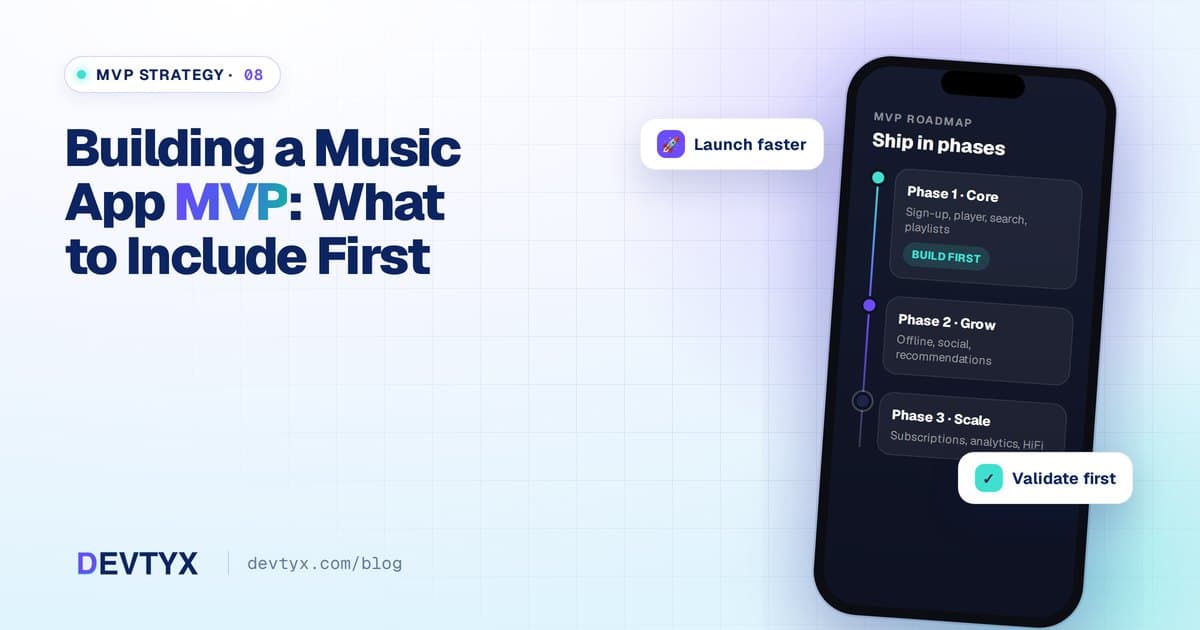
Step 3: Include These MVP Features
| Feature | Why it's in the MVP |
|---|---|
| Sign-up and login | Needed to save libraries and track usage |
| Audio player with background play | The core experience |
| Search and browse | Users must find content |
| Likes and playlists | Basic personalization and retention |
| Your differentiating feature | The reason users choose you |
| Basic admin panel | Upload and manage content |
| Analytics | Learn what users actually do |
Step 4: Leave These for Later
- AI recommendations (use editorial playlists first)
- Social feeds and comments
- Desktop, TV and watch apps
- Lyrics, podcasts and video
- Complex royalty dashboards
- Multiple subscription tiers
Each of these is valuable, but none is required to test your core promise.
Step 5: Pick a Cost-Effective Tech Approach
A cross-platform framework like Flutter or React Native lets one team ship iOS and Android together. This is why many founders hire a hybrid mobile app development company for their MVP. Pair it with managed cloud services so you don't have to maintain servers early on.
Read Native vs Flutter vs React Native for Music Apps to choose.
Step 6: Define Success Metrics
Before launch, decide what success looks like:
- Day-1, day-7 and day-30 retention
- Average listening minutes per user per day
- Number of playlists created
- Use of your differentiating feature
- Conversion to paid (if you charge)
MVP Cost and Timeline
| MVP type | Estimated cost (USD) | Timeline |
|---|---|---|
| Single-platform player | $25,000 – $40,000 | 3 months |
| Cross-platform iOS and Android | $35,000 – $60,000 | 3 – 4 months |
| Cross-platform plus web player | $45,000 – $75,000 | 4 – 5 months |
For full-platform costs, see our music app development cost guide.
Step 7: Launch, Learn, Iterate
- Launch to a small group first, such as a beta community or one city
- Interview users and watch analytics weekly
- Fix friction in the player and onboarding first
- Add the next feature based on evidence, not guesses
Mistakes to Avoid
- Building every Spotify feature before launch
- Skipping analytics
- Choosing a tech stack that can't scale
- Ignoring licensing until after launch
- Launching without a plan to reach your first 1,000 users. See How to Launch and Market a New Music App.
Frequently Asked Questions
What should a music app MVP include?
Sign-up, a reliable audio player with background play, search, likes and playlists, a basic admin panel, analytics and one differentiating feature that makes your app worth choosing.
How much does a music app MVP cost?
A music app MVP typically costs $25,000–$60,000 for a cross-platform iOS and Android app, or $45,000–$75,000 if you add a web player.
How long does it take to build a music app MVP?
Most music app MVPs take 3–4 months from discovery to launch when the scope stays focused on core features and one differentiator.
Should my MVP be native or hybrid?
Most MVPs should be hybrid. A hybrid mobile app development company can build iOS and Android from one codebase, reaching more users with a smaller budget.
Build Your Music App MVP With DEVTYX
DEVTYX helps founders scope, design and launch music app MVPs in about 3–4 months. As a hybrid app development company, we build iOS and Android together, so your MVP reaches more users for less. Projects usually start within 2 weeks.
Book a free strategy call with our music app developers.