
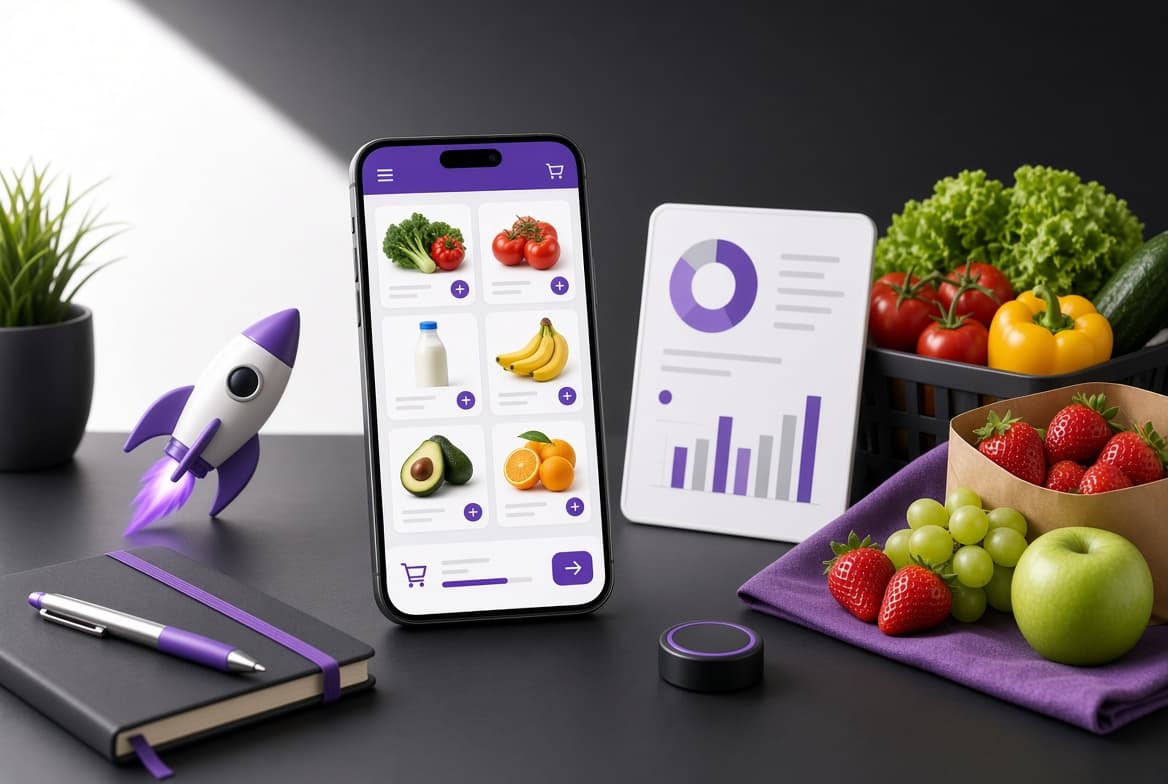
Grocery delivery looks simple from the outside: browse, add to cart, pay, wait for the doorbell. Behind it sit live inventory, product substitutions, delivery slots and payments that change after an order is picked. That hidden complexity is why so many grocery startups spend their first budget building a "mini Instacart" before they have a single repeat customer.
Smart app development for startups works the other way around. You launch the smallest product that proves people will order from you again, then grow it using real order data. This guide shows how to do that for a grocery delivery business: what to build first, what to postpone, what it typically costs and which mistakes drain early budgets. If you already know what you want to build, explore our grocery app development services.
Why Grocery Startups Overspend on Their First App
Most budget overruns in grocery startup app development come from a handful of predictable decisions:
- Building every app at once. Customer, driver, picker, vendor and admin apps all ship on day one, even though only two are needed to take orders.
- Copying a market leader feature for feature. Large platforms built their apps over years. A new grocery brand doesn't need their full feature set to win a neighborhood.
- Launching several fulfillment models. Scheduled delivery, rapid delivery, curbside pickup and in-store shopping each add their own rules, screens and tests.
- Custom-building commodity features. Payments, maps, authentication and push notifications are solved problems. Building them from scratch spends money customers never notice.
- Underestimating catalog data. Thousands of products, frequent price changes and out-of-stock items need a reliable process, not just a nice product screen.
- Serving too many areas too soon. Every extra delivery zone multiplies fees, driver logistics, support and testing.
- Skipping discovery. In app development for startup teams, jumping straight into code without agreed scope is the fastest way to pay for the same feature twice.
Each of these adds design, engineering and testing work before you know which part of your idea customers actually value.
What a Grocery Delivery MVP Actually Needs
A minimum viable product is not a smaller copy of everything. It is the narrowest complete loop: a customer finds products, pays, receives the order, and your team can fulfill it reliably. For most grocery startups, that loop needs just two products: a customer app and an admin panel.
| Area | Must-have at launch | Can wait until later |
|---|---|---|
| Customer app | Account and address, catalog and search, cart, checkout, delivery or pickup slot, order status, push notifications | Wishlists, recipes, AI recommendations, social sharing |
| Payments | Cards and wallets through an established provider, refunds for missing items | Loyalty points, subscriptions, buy now pay later |
| Admin panel | Products, prices and stock (with bulk import), orders, slots and delivery zones, basic reports | Advanced analytics, multi-store management, vendor payouts |
| Fulfillment | Staff pick from a simple order screen; your own drivers or a courier partner update status | Dedicated picker app, route optimization, full driver app |
| Support | Email or chat support, order notifications | In-app chat between shopper and driver |
This matches what Creole Studios lists as the minimum for a focused grocery store app: one store or fulfillment location, registration, catalog and search, cart, online payment, delivery or pickup selection, order status updates, a store admin dashboard and push notifications (Creole Studios).
Grocery-Specific Rules to Decide Early
Some grocery decisions are business rules as much as code. Settle them during discovery to avoid expensive rework later:
- Substitutions: Can customers allow replacements, choose their own, or refuse them?
- Weighted items: How will you charge for produce, meat and deli items whose final weight differs from the estimate?
- Slot capacity: How many orders can your team pick and deliver per time slot?
- Delivery zone: One neighborhood, a radius around the store, or a set of postcodes?
- Minimum order and fees: What basket size and delivery fee make each order worth fulfilling?
How Much Does a Grocery Delivery MVP Cost?
Published 2026 estimates give a useful starting point. These are typical industry ranges, not quotes:
| Stage | Typical cost (USD) | Typical timeline | Source |
|---|---|---|---|
| Clickable prototype | $8,000 – $20,000 | 3 – 6 weeks | Creole Studios |
| Single-store MVP, senior offshore team | $20,000 – $45,000 | 10 – 16 weeks | Innovation Insight |
| Single-store or basic MVP, general market | $25,000 – $70,000 | 3 – 5 months | F22 Labs, Creole Studios, Go Tech Solutions |
| Multi-store marketplace MVP (Instacart-like), senior offshore team | $49,000 – $90,000 | 12 – 22 weeks | Innovation Insight |
Remember the running costs too. Stripe charges 2.9% + 30¢ per successful domestic card transaction in the U.S. (Stripe pricing). Apple's developer program costs $99 per year (Apple), and Google Play has a one-time $25 registration fee (Google Play). Annual maintenance commonly runs 15–25% of the original build cost (Creole Studios).
For the full picture by module, platform, team location and development phase, read our grocery delivery app cost breakdown.
A Step-by-Step Plan to Launch Without Overspending
1. Validate Demand Before You Write Code
Talk to the shoppers you want to serve. Map local competitors and their delivery fees, and test your offer with a simple landing page or a manual ordering pilot. If people won't order through a basic channel, a polished app won't fix that.
2. Pick One Niche, One Fulfillment Model and One Zone
"Groceries for everyone, everywhere" is not a launch plan. Choose a clear angle, such as fresh produce, ethnic groceries, organic, or late-night essentials. Then pick one fulfillment model and one delivery area. You can expand once your unit economics work.
3. Run a Short Discovery Sprint
Good mobile app development consulting at the start saves far more than it costs. In a one- to two-week discovery phase, you define user flows, must-have features, integrations and a realistic roadmap and estimate. At Devtyx, discovery and strategy typically takes 1–2 weeks, followed by 2–3 weeks of design and architecture.
4. Prototype the Tricky Flows
Substitutions, weighted items, slot selection and checkout are where grocery apps get complicated. Prototype them in Figma and test them with a handful of real shoppers before engineering starts. Changing a prototype is much cheaper than changing code.
5. Choose Cross-Platform Unless You Have a Clear Reason Not To
React Native and Flutter let one codebase serve both iOS and Android, so you can launch on both stores with one team. Go Tech Solutions estimates cross-platform builds at roughly 20–40% cheaper than separate native apps. For a detailed comparison, see cross platform app development vs native for grocery apps.
6. Use Proven Services for the Plumbing
Use an established payment provider, a maps platform and a push notification service instead of building your own. Google Maps Platform, for example, includes 10,000 free monthly events for each Essentials service before per-request pricing starts (Google Maps Platform pricing). That is plenty for a small launch zone if you cache addresses.
7. Build in Short Sprints With Regular Demos
The right MVP software development services team works in short, visible increments. Devtyx runs two-week sprints with weekly demos, so you see progress before each invoice and can re-prioritize features as you learn.
8. Launch, Measure, Then Expand
After launch, track the numbers that show whether your grocery model works:
- Repeat order rate: Do customers come back within a week or two?
- Average basket size: Is each order large enough to cover picking and delivery?
- Order accuracy: How often are items missing, wrong or substituted?
- On-time delivery: Are you keeping the slot promises you make?
- Cost per delivery and acquisition cost: Can you acquire and serve customers profitably?
When to Add the Driver App, Picker App and Marketplace Features
Let real operating problems decide your roadmap, not a feature wish list. Go Tech Solutions gives similar advice: two panels (customer and admin) get you live, and driver and vendor panels can come once volume justifies them.
| Signal you see | What to add next |
|---|---|
| Staff struggle to pick orders accurately as volume grows | Picker app with barcode scanning and substitution approval |
| Your own delivery fleet grows and manual dispatch breaks down | Driver app with assignment, navigation and proof of delivery |
| Customers ask for more stores or categories | Multi-store catalog, then a vendor portal with payouts |
| A loyal base orders regularly | Reorder lists, loyalty and subscriptions |
| You have months of order history | AI recommendations and demand forecasting |
How to Choose the Right Development Partner
For a startup, the right software development partner matters more than the lowest hourly rate. Look for:
- Grocery and commerce understanding: they ask about substitutions, slots and inventory, not just screens.
- Senior engineers on critical work: rework from inexperienced teams can erase any rate savings.
- Transparent pricing: a clear choice between fixed-price and time-and-materials engagements.
- Full IP ownership: you should own your source code outright.
- Visible progress: regular demos and access to the work in progress.
- Post-launch support: monitoring, updates and a roadmap for the next phases.
Affordable software development comes from honest scoping and getting it right the first time, not from cutting corners.
How Devtyx Helps Grocery Startups Launch Lean
Devtyx has been building web, mobile and AI products since 2019, with 70+ digital products shipped for clients in 23+ countries. Every engagement is senior-led, and you get full source code ownership plus a choice of fixed-price or time-and-materials pricing.
As an MVP software development company, we focus startup mobile app development on a lean first release for grocery founders: a cross-platform customer app built with React Native or Flutter, an admin panel and cloud infrastructure on AWS, Azure or Google Cloud that can grow with your order volume. When you are ready for driver apps, picker apps or a multi-vendor marketplace, the same team can extend your custom grocery delivery app without a rebuild.
Frequently Asked Questions
What is the best approach to app development for startups in grocery delivery?
Start with a narrow MVP: one customer app and one admin panel, one fulfillment model and one delivery zone. Validate demand and unit economics, then add driver, picker and vendor apps as volume grows.
How much does a grocery delivery MVP cost?
Published 2026 estimates put a single-store grocery MVP at roughly $20,000–$70,000, depending on scope and team location. A multi-store marketplace MVP costs more. A clickable prototype typically costs $8,000–$20,000.
How long does it take to launch a grocery delivery MVP?
A focused single-store MVP typically takes about 10 weeks to 5 months, depending on scope, integrations and how quickly decisions are made. Marketplace MVPs usually take longer.
Do I need a driver app at launch?
Not always. Many startups begin with their own staff or a courier partner updating order status through the admin panel. A dedicated driver app makes sense once your fleet grows and manual dispatch slows you down.
Should my grocery MVP be native or cross-platform?
For most grocery MVPs, cross-platform development with React Native or Flutter is faster and cheaper because one codebase serves iOS and Android. Native makes sense for unusually performance-heavy or device-specific features.
What should I look for in MVP software development services?
Look for a team that challenges your scope, understands grocery workflows, works in short sprints with demos, offers transparent pricing and hands over full source code ownership.
Ready to Launch Your Grocery Delivery MVP?
You don't need a massive budget to start. You need a focused plan and a team that builds the right things first. Tell us about your grocery idea and our grocery app development team will help you shape a lean MVP scope, timeline and cost range. We reply within 24 hours.
Book a Free Grocery MVP Consultation
Cost figures in this article are typical industry estimates from public sources (checked October 2026) for general planning only. They are not a Devtyx quote.
Sources
- Creole Studios: Grocery App Development Cost in 2026
- Innovation Insight: Grocery Delivery App Development Cost in 2026
- Go Tech Solutions: Grocery App Development Cost in 2026
- F22 Labs: Grocery Delivery App Development Cost Guide 2026
- Stripe: Pricing
- Google Maps Platform: Pricing
- Apple Developer: Program enrollment
- Google Play Console Help: Get started with Play Console