
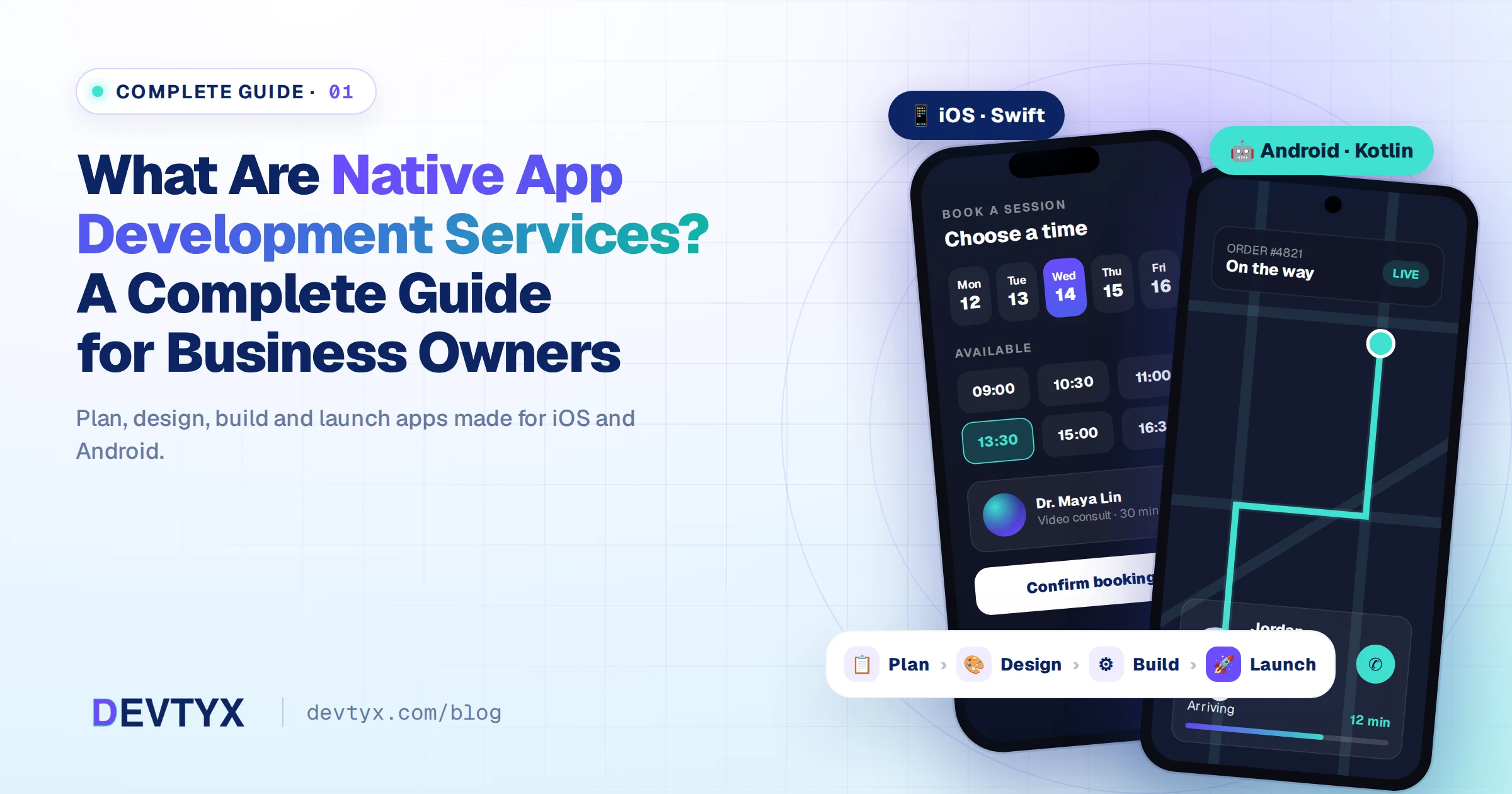
You have an idea for a mobile app, or you know your business needs one. Then the search begins, and you run into terms like "native," "cross-platform," "discovery phase" and "UAT." It is easy to feel lost before you even start.
This guide explains, in plain language, what native app development services are, what you get when you hire a team, how long it takes, and the questions to ask before you sign. No technical background needed.
What Are Native App Development Services?
Native app development services are the professional services involved in planning, designing, building, testing, launching and maintaining a mobile app made specifically for one operating system: iOS (iPhone and iPad) or Android. Each app is written in that platform's own programming language, Swift for iOS and Kotlin for Android.
Think of it like tailoring a suit. A native app is cut to fit the platform exactly, so it runs faster, looks right and can use every feature of the phone, from Face ID and the camera to GPS and push notifications.
Native Apps vs Other Types of Apps
Before you hire anyone, it helps to know your options.
| App type | How it is built | Best for |
|---|---|---|
| Native app | Separate apps in Swift (iOS) and Kotlin (Android) | Top performance, security and user experience |
| Cross-platform app | One shared codebase with React Native or Flutter | Faster launch on both platforms, tighter budgets |
| Hybrid or web app | Web technologies inside an app shell, or a mobile website | Simple tools, prototypes, content-only apps |
Native is the premium option. It usually costs more and takes longer to build for both platforms, but it delivers the best experience for your users.
What Is Included in Native Mobile App Development Services?
A full-service team handles your app from first idea to life after launch. Here is what each stage includes.
1. Discovery and Strategy
Every good app starts with questions, not code. In discovery, the team learns about your business goals, target users, competitors and budget. Together, you decide which features belong in the first version and which can wait.
You receive: a project scope, feature list, rough timeline and cost estimate.
2. UI/UX Design
Designers map out how users move through your app (user experience, or UX) and how each screen looks (user interface, or UI). They start with simple wireframes, then build a clickable prototype you can tap through on your own phone before any code is written.
You receive: wireframes, a clickable prototype and final screen designs that follow Apple and Google design guidelines.
3. Native Development With Swift and Kotlin
This is where your app comes to life. iOS developers build with Swift and SwiftUI. Android developers build with Kotlin and Jetpack Compose. Backend developers create the servers, databases and APIs that power features like logins, payments and data syncing.
Most teams work in two-week "sprints," showing you a working version at the end of each one so you can give feedback early.
You receive: regular demos, access to test builds and a working app that grows feature by feature.
4. Quality Assurance (QA) and Testing
Testers check that everything works on real devices, different screen sizes and different OS versions. They test speed, security, battery use and edge cases, like what happens when the internet drops mid-payment.
Then comes User Acceptance Testing (UAT), where you and your team use the app to confirm it does what your business needs.
You receive: a tested, stable app ready for real users.
5. App Store Launch
Publishing an app is not as simple as uploading a file. Apple and Google each have review guidelines, required screenshots, privacy disclosures and store listings. A good agency handles submission and fixes any review issues so your launch stays on schedule.
You receive: a live app on the App Store and Google Play.
6. Ongoing Support and Maintenance
Apple and Google release major OS updates every year, and your users will ask for new features. Support keeps your app secure, compatible and improving after launch.
You receive: bug fixes, OS updates, performance monitoring and new feature releases.
How Long Does Native App Development Take?
Timelines depend on how complex your app is and whether you are building for one platform or two. These are typical ranges, not promises.
| App complexity | Example | Typical timeline |
|---|---|---|
| Simple | Booking app, internal tool, basic content app | 2–4 months |
| Medium | E-commerce app, social features, payments | 4–7 months |
| Complex | Fintech, healthcare, real-time or AI-powered apps | 7–12+ months |
Discovery and design usually take the first 3–6 weeks. A focused minimum viable product (MVP) is the fastest way to get to market, and then you can add features based on real user feedback.
Who Needs Native App Development Services?
Native development is a strong fit when:
- Your app handles sensitive data, like banking, payments or health records.
- Speed and smooth performance are central to the experience.
- You need deep access to device features such as Bluetooth, the camera, biometrics or wearables.
- Your users expect a premium experience, and your brand depends on it.
- Most of your customers use one platform, like iPhone users in the US.
If speed to market and budget matter more than peak performance, a cross-platform app may be the smarter first step. A trustworthy agency will tell you which approach fits, even if it is the less expensive one.
Questions to Ask a Native App Development Agency
Choosing the right partner matters as much as choosing the right technology. Ask these questions before you sign:
- Can I see native apps you have built? Ask for live App Store and Google Play links, not just screenshots.
- Who will work on my project? Find out the team size, roles and whether developers are in-house or subcontracted.
- How do you price projects? Fixed price, hourly or monthly retainer? What is included, and what costs extra?
- How will we communicate? Ask about weekly demos, project management tools, response times and time zone overlap.
- Who owns the code? You should own the source code, designs and intellectual property, with access to the code repository from day one.
- How do you test apps? Look for real-device testing, automated tests and a clear UAT process.
- Do you handle App Store submission? The answer should be yes.
- What happens after launch? Ask about support plans, bug-fix warranties and the cost of updates.
- How do you handle security and privacy? This is especially important for finance and healthcare apps.
Red flags to watch for: a price quote without any discovery, no access to your own code, vague answers about who is building the app, and no plan for life after launch.
How DEVTYX Delivers Native App Development Services
At DEVTYX, we guide business owners through every step, from the first idea to a live app and beyond. Since 2021, we have delivered 70+ digital products for 120+ clients across 23+ countries, with 98% client satisfaction.
- Clear, upfront pricing: fixed-price projects or monthly retainers, agreed after a free discovery call
- Fast start: most projects kick off within about two weeks of our first conversation
- Full lifecycle team: strategy, UI/UX design, Swift and Kotlin development, QA, launch and support
- Full ownership: you own your code, designs and IP from day one
- Responsive support: we reply to every inquiry within 24 hours
Learn more about our native mobile app development services and the apps we build for US businesses.
Frequently Asked Questions
What is the difference between native app development and app development in general?
App development is the broad term for building any mobile app. Native app development specifically means building separate apps for iOS and Android in each platform's own language, which gives the best performance and user experience.
Do I need both an iOS and an Android app?
Not always. If most of your customers use one platform, starting with a single native app saves time and money. You can add the second platform once the first one proves itself.
Can I update my app after it launches?
Yes. Apps are never really "finished." Most businesses release updates regularly to fix bugs, support new OS versions and add features users ask for.
What do I need to prepare before contacting an agency?
A short description of your idea, your target users, a few apps you like and a rough budget range. That is enough to start a productive discovery call.
Ready to Turn Your Idea Into an App?
You do not need to know Swift, Kotlin or app store rules to build a great app. You just need the right partner. Tell us about your idea, and we will map out the features, timeline and budget in a free discovery call.
Explore our native app development services and book your free discovery call today.