
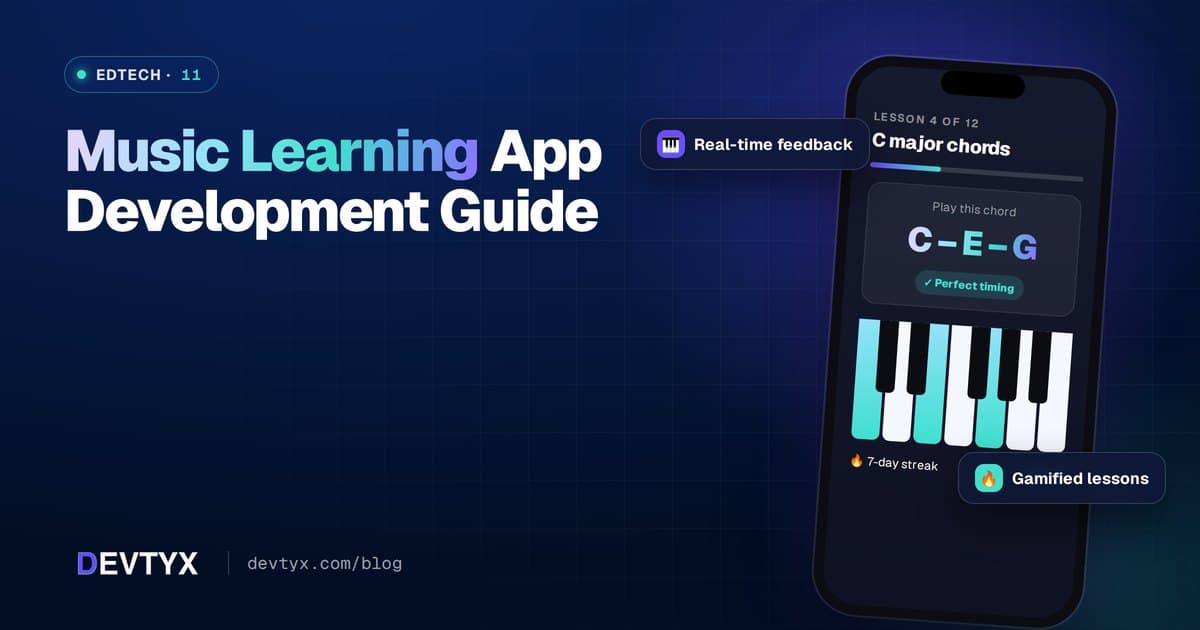
Learning Music Has Moved to the Phone
Millions of people learn guitar, piano, singing and music theory with apps. A good music learning app listens to the student, gives instant feedback and keeps them practicing with goals and rewards.
This guide covers what it takes to build one.
Types of Music Learning Apps
- Instrument lessons: guitar, piano, ukulele, drums, violin
- Vocal training: pitch, range and breathing exercises
- Music theory and ear training: intervals, chords, rhythm and sight reading
- Teacher platforms: live or recorded lessons with real teachers
- School and academy apps: courses, assignments and progress tracking for students
Core Features
- Structured courses by level
- Video lessons with slow-motion and looping
- Interactive sheet music or tabs that scroll with the music
- Real-time feedback using the microphone
- Practice tools: metronome, tuner, backing tracks
- Progress tracking and practice streaks
- Achievements, badges and levels
- Offline lessons
- Teacher messaging or live sessions
The Key Technology: Listening to the Student
Real-time feedback is what makes a learning app feel magical. It relies on:
- Pitch detection to check notes and tuning
- Onset and rhythm detection to check timing
- Chord recognition for guitar and piano
- MIDI support to connect digital keyboards and e-drums directly
These features need low-latency audio processing. Many teams use native audio modules (Swift and Kotlin, or C++ libraries) inside a cross-platform app. See Native vs Flutter vs React Native for Music Apps.
Gamification and Mobile Game UI
Learning apps borrow heavily from games:
- Note highways like rhythm games
- Points, streaks and leaderboards
- Unlockable songs and levels
- Daily challenges
A strong mobile game UI keeps practice fun. For simpler gamified screens, Flutter's rendering engine works well. For full rhythm games, cross platform mobile game development with an engine such as Unity may be the best software for mobile game development, connected to your main app.
Content and Licensing
Teaching popular songs requires rights to the compositions, and sometimes the recordings. Many apps start with original exercises, public-domain classics and licensed arrangements. Plan licensing early. See Music Licensing Explained for App Founders.
Monetization
- Monthly or yearly subscriptions (the most common model)
- Free starter lessons with paid courses
- One-time course or song pack purchases
- Teacher marketplace commissions
- B2B licenses for schools
Tech Stack
| Layer | Options |
|---|---|
| App | Flutter or React Native with native audio modules |
| Audio analysis | Native DSP libraries, pitch detection algorithms, MIDI APIs |
| Video | HLS streaming with a CDN |
| Backend | Node.js or Python, PostgreSQL |
| Gamification | Custom engine or Unity for advanced games |
Cost and Timeline
| Scope | Estimated cost (USD) | Timeline |
|---|---|---|
| Video course app with progress tracking | $25,000 – $50,000 | 3 – 4 months |
| Interactive app with pitch detection | $60,000 – $120,000 | 5 – 8 months |
| Full gamified platform with teacher marketplace | $120,000 – $250,000+ | 8 – 12 months |
Frequently Asked Questions
How do music learning apps hear what the student plays?
They use the microphone with pitch detection, rhythm detection and chord recognition, or connect to digital instruments via MIDI, to compare the student's performance with the expected notes.
How much does a music learning app cost?
A video course app costs about $25,000–$50,000. An interactive app with pitch detection costs $60,000–$120,000, and a gamified platform with a teacher marketplace can exceed $120,000.
Can music learning apps use game mechanics?
Yes. Points, streaks, levels and rhythm-game style note highways keep students practicing. A polished mobile game UI is one of the biggest drivers of daily engagement.
Is cross platform mobile game development suitable for learning apps?
Yes. Light gamification works well in Flutter, while full rhythm games can use engines like Unity. Both support iOS and Android from one codebase.
Build Your Music Learning App With DEVTYX
DEVTYX builds music learning apps with interactive feedback, gamified UI and scalable video delivery. As a hybrid mobile app development company, we ship iOS, Android and web together, with native audio where accuracy matters.
Talk to our music app developers about your learning app.