
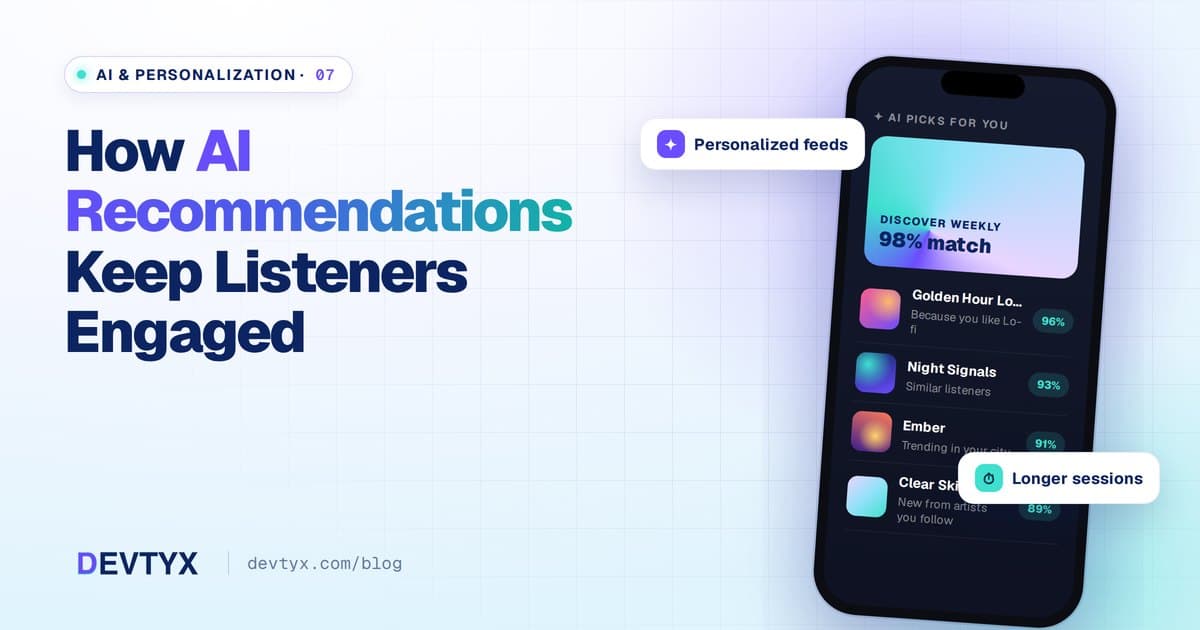
Discovery Is the Feature Listeners Remember
When a music app plays exactly the right song at the right moment, listeners notice. When the app keeps suggesting the same tracks, they leave. AI-powered recommendations are now an expected feature in music streaming app development, not a luxury.
Here's how they work, and how to add them to your app.
Why Recommendations Matter
Good recommendations:
- Increase listening time per session
- Help users discover new artists, which improves catalog value
- Reduce "what do I play now?" friction
- Give a reason to come back daily through fresh mixes
- Support niche and indie artists who'd otherwise be hard to find
The Main Recommendation Methods
1. Collaborative Filtering
"Listeners who liked this also liked that." The system finds patterns across many users' behavior. It's powerful but needs a lot of data.
2. Content-Based Filtering
The system looks at the music itself and its metadata: genre, tempo (BPM), key, energy, mood, instruments and language. It recommends tracks similar to what the user already enjoys. This works even for new songs with no play history.
3. Audio Analysis With Machine Learning
Models analyze audio directly to extract features such as tempo, timbre and energy, or to create "embeddings" that place similar-sounding songs close together.
4. Context-Aware Recommendations
The app considers time of day, day of week, activity (workout, focus, sleep), device and session length. A morning commute mix shouldn't sound like a late-night playlist.
5. Hybrid Systems
Most real platforms combine all of the above, often blended with human editorial curation.
Solving the Cold-Start Problem
New apps don't have millions of listening sessions. Here's how to recommend well from day one:
- Onboarding questions: ask users to pick favorite genres and artists
- Editorial playlists: curated by experts in your niche
- Popularity and trending charts: simple but effective early on
- Content-based similarity: works without user history
- Gradual personalization: shift toward collaborative filtering as data grows
Signals That Matter
| Signal | What it tells you |
|---|---|
| Full plays | Strong positive interest |
| Skips in the first 30 seconds | Negative signal |
| Likes and saves | Strong positive |
| Playlist adds | Very strong positive |
| Repeat plays | Favorite track |
| Search queries | Active intent |
| Shares | High enthusiasm |
Features Powered by AI
- Daily and weekly personalized mixes
- "Because you listened to" rows
- Smart shuffle that adds similar tracks
- Radio stations built from any song or artist
- Mood and activity playlists
- Natural-language search ("upbeat songs for running")
- AI-generated playlist titles and covers
- Auto-tagging of uploaded tracks for genre and mood
Privacy and Trust
Recommendation systems use listening data, so handle it carefully:
- Collect only what you need
- Explain personalization in your privacy policy
- Let users reset their taste profile or hide tracks
- Follow GDPR and CCPA rules where they apply
A Note on Third-Party APIs
Some founders plan to use Spotify's recommendation endpoint. As of 2026, Spotify has removed recommendations and audio-features endpoints for new apps (Spotify developer changes), so plan to build your own recommendation logic.
Cost and Timeline
| Approach | Typical cost (USD) |
|---|---|
| Rules, charts and editorial playlists | $5,000 – $10,000 |
| Content-based and basic collaborative filtering | $10,000 – $25,000 |
| Full machine-learning recommendation system | $25,000 – $60,000+ |
Frequently Asked Questions
How do music app recommendations work?
They combine collaborative filtering (what similar listeners enjoy), content-based filtering (song features like tempo and genre), context such as time and activity, and often human editorial curation.
How can a new music app recommend songs without data?
Use onboarding questions, editorial playlists, trending charts and content-based similarity. As listening data grows, gradually shift toward collaborative filtering and machine learning models.
Can I use Spotify's API for recommendations?
Not for new apps. As of 2026, Spotify has removed its recommendations and audio-features endpoints for new developer apps, so platforms need their own recommendation logic.
How much does an AI recommendation system cost?
A rules-and-charts approach costs about $5,000–$10,000. Content-based and basic collaborative filtering cost $10,000–$25,000, and a full machine-learning system can cost $25,000–$60,000 or more.
Build Smarter Music Apps With DEVTYX
DEVTYX builds Data and AI solutions for production scale, including recommendation engines for music and audio platforms. As a music app development company and hybrid mobile app development company, we connect AI services to your iOS, Android and web apps from one codebase.
Talk to our music app developers about adding personalization to your app.