
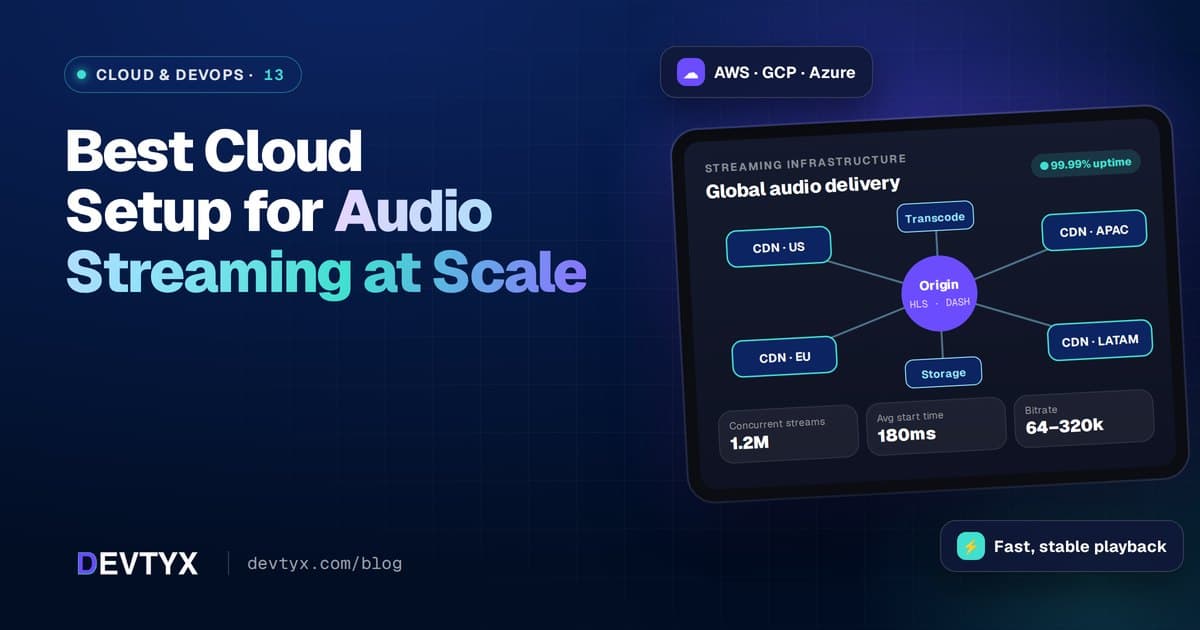
Infrastructure Makes or Breaks a Streaming App
Listeners judge a music app in the first few seconds of playback. If tracks are slow to start or buffer on mobile data, they leave. Behind every smooth stream is a well-designed cloud setup.
This guide explains the building blocks of audio streaming infrastructure and how to scale them.
The Core Building Blocks
1. Object Storage
Store original uploads and transcoded files in object storage such as AWS S3, Google Cloud Storage or Azure Blob Storage. Keep originals separate from streaming files, and use lifecycle rules to move rarely played content to cheaper storage tiers.
2. Transcoding Pipeline
Every uploaded track is converted into streaming formats:
- Multiple bitrates, for example 96, 160 and 320 kbps AAC or Opus
- Optional lossless FLAC or ALAC for hi-fi tiers
- Loudness normalization so tracks play at similar volume
- Waveform and preview clip generation
Use managed services like AWS Elemental MediaConvert, or FFmpeg in serverless functions or containers.
3. Adaptive Streaming (HLS and DASH)
Audio is split into short segments with a manifest listing available bitrates. The player switches quality as the network changes, so playback continues instead of stopping. HLS is the standard on Apple devices and widely supported elsewhere.
4. Content Delivery Network (CDN)
A CDN caches audio segments close to listeners. Popular options include Amazon CloudFront, Google Cloud CDN, Azure Front Door and Cloudflare. Use signed URLs or tokens so only authorized users can stream.
5. Databases and Caching
| Data | Recommended store |
|---|---|
| Catalog metadata, users, playlists | PostgreSQL |
| Sessions, counters, hot data | Redis |
| Search | Elasticsearch, OpenSearch or Algolia |
| Listening events and analytics | Data warehouse such as BigQuery, Redshift or Snowflake |
6. Application Services
APIs for accounts, playlists, search, payments and recommendations, typically running in containers (Kubernetes, ECS, Cloud Run) or serverless functions.
Reference Architecture
- Artist or admin uploads a track
- Upload lands in storage and triggers transcoding
- Transcoded HLS segments are saved and metadata is indexed
- Listener requests a track through the API
- API checks the subscription and returns a signed CDN URL
- Player streams segments from the nearest CDN edge
- Playback events flow into analytics and recommendations
Scaling Tips
- Pre-warm caches before big releases
- Autoscale APIs on traffic, not just CPU
- Cache metadata aggressively; it changes rarely
- Separate read and write databases as traffic grows
- Use multiple regions for global audiences
- Monitor playback quality: start time, buffering rate and errors, not just server uptime
Security
- Signed URLs with short expiry
- DRM for licensed content. See DRM and Content Protection for Music Apps
- Encryption at rest and in transit
- Rate limiting to stop scraping
- Least-privilege access for your team
Controlling Cloud Costs
CDN bandwidth is usually the biggest streaming cost. Reduce it by:
- Choosing efficient codecs like Opus or AAC
- Defaulting mobile data users to sensible bitrates
- Caching offline downloads so repeat plays don't stream again
- Negotiating committed-use discounts once traffic is predictable
- Reviewing storage tiers for old content
AWS vs Google Cloud vs Azure
All three can run world-class streaming platforms. Choose based on your team's experience, existing contracts, regional coverage and pricing. Many platforms also use a separate CDN such as Cloudflare.
Frequently Asked Questions
What is the best cloud for audio streaming?
AWS, Google Cloud and Azure can all run large streaming platforms. The best choice depends on your team's experience, regional coverage, existing contracts and pricing.
Why do music apps use HLS or DASH?
HLS and DASH split audio into short segments at several bitrates, so the player can switch quality as the network changes and keep playing instead of buffering.
What is the biggest cost in audio streaming infrastructure?
CDN bandwidth is usually the largest cost. Efficient codecs, sensible default bitrates and offline caching help keep it under control.
Do I need a CDN for a music app?
Yes. A CDN caches audio close to listeners, which reduces start time and buffering and protects your origin servers during traffic spikes.
Build Scalable Streaming Infrastructure With DEVTYX
DEVTYX provides Cloud, DevOps and Security services on AWS, Google Cloud and Azure, alongside audio streaming app development. As a hybrid app development company and enterprise app development services partner, we build both the apps and the infrastructure behind them.
Talk to our music app developers about your streaming architecture.